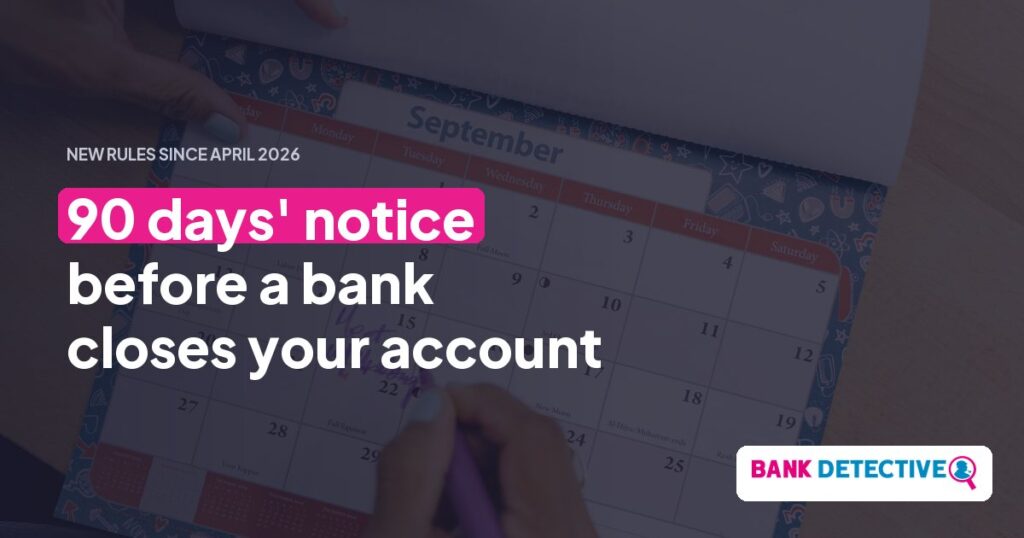
Since 28 April 2026, a bank that wants to close a current account opened on or after that date must give 90 days’ notice and explain its reasons in writing. The previous minimum was two months.
What changed on 28 April 2026?
The Payment Services and Payment Accounts (Contract Termination) (Amendment) Regulations 2025 came into force on 28 April 2026. The Treasury made them on 12 June 2025 as Statutory Instrument 2025 No. 688.
For an account opened on or after 28 April 2026, the provider must send a termination notice at least 90 days before the closure takes effect. The notice has to include:
- an explanation of the reasons, detailed and specific enough for the customer to understand why the account is being closed;
- how to complain to the provider;
- any right to complain to the Financial Ombudsman Service.
Does it apply to an account I already have?
Only if you opened it on or after 28 April 2026. A contract entered into before that date keeps the earlier rule: at least two months’ notice, where the contract provides for it.
The date that counts is the date of the contract, not the date of the closure. An account opened in March 2026 can still be closed on two months’ notice in 2027. An account opened in May 2026 carries the 90-day rule.
Must the bank tell me why?
For contracts from 28 April 2026, yes. The regulations require the reasons to be sufficiently detailed and specific. The Treasury’s announcement of 28 April 2025 says the aim is that customers can challenge a decision, including through the Financial Ombudsman Service.
The regulations make an exception where giving the information would be unlawful. A bank cannot tell you something it is legally barred from disclosing.
When can a bank still close an account without 90 days’ notice?
The regulations set two groups of exceptions.
No termination notice is required where the provider:
- cannot complete customer due diligence checks under the money laundering rules;
- must close the account under the Immigration Act 2014;
- has reasonable grounds to suspect the account is used in connection with a serious crime;
- is required by the FCA, the Treasury or the Secretary of State to terminate the contract;
- reasonably believes the customer has used the account in connection with an offence committed while providing goods or services to others.
The 90-day minimum does not apply, though a notice must still go out without delay, where the provider considers that the customer’s conduct towards its staff amounts to certain harassment or public order offences, or where the customer gave incorrect information that would have stopped the provider opening the account.
What should you do if you receive a closure notice?
- Note the closure date and read the reasons given.
- List what runs through the account: salary, direct debits, standing orders and any card linked to a subscription.
- Open a replacement account before the closure date and move those payments across.
- If you disagree with the decision, complain to the bank first. The notice must tell you how.
- If the complaint does not settle it, the notice must tell you of any right to go to the Financial Ombudsman Service.
With 90 days available, there is time to move payments in stages and check that each one arrived.
Quick answers
Does the rule cover basic bank accounts?
Yes. The same instrument amends the Payment Accounts Regulations 2015: for a framework contract entered into on or after 28 April 2026 the notice period is at least 90 days.
Can I still close my own account quickly?
Yes. The customer may terminate the contract at any time, unless the parties agreed a notice period of up to one month.
Does the 90-day rule apply across the UK?
Yes. The regulations extend to England and Wales, Scotland and Northern Ireland.
Sources
- legislation.gov.uk: The Payment Services and Payment Accounts (Contract Termination) (Amendment) Regulations 2025, SI 2025/688.
- GOV.UK: HM Treasury announcement, 28 April 2025.
Sources checked on 2 October 2026.